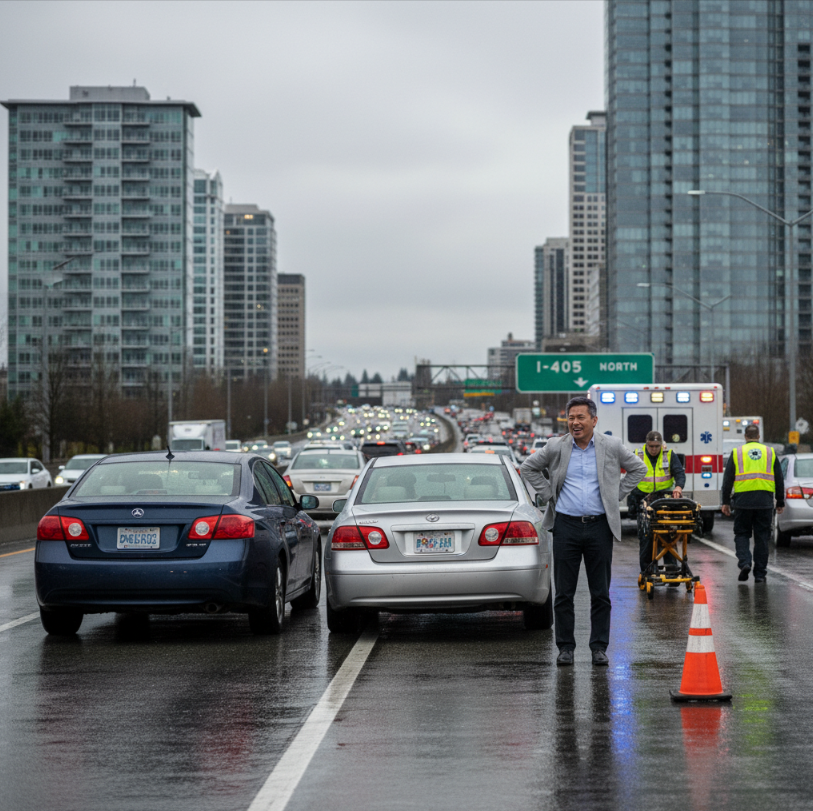
A car accident can change your life in seconds. One moment you’re driving across Bellevue on I-405 or heading home along NE 8th Street — the next, you’re faced with intense back or neck pain that won’t go away. For many crash victims, that persistent pain is caused by a herniated disc from car accident injuries. Unlike minor soreness, a herniated disc can cause chronic pain, nerve damage, limited mobility, and may require surgery. It can affect your ability to work, care for your family, or simply live without constant discomfort. According to national crash data reported by the NHTSA, there are over 5 million motor vehicle collisions annually in the U.S., and spine-related injuries are common. In Washington State, thousands of injury crashes happen each year, and medical providers frequently diagnose herniated or bulging discs among the most serious back and neck injuries.
👉 Looking for a Personal Injury Lawyer Near Tacoma, WA? Contact R Martin Law Group today for a free consultation.
What Is a Herniated Disc?
Understanding the injury helps both your recovery and any legal claim you might make.
Your spine is made up of vertebrae cushioned by soft, gel-like discs that act as shock absorbers. When a disc is damaged — often by sudden force or trauma — the inner material can push through the outer layer. That is a herniated disc (sometimes called a slipped or ruptured disc).
Common Symptoms
Cervical Spine (Neck) Herniation
- Neck pain
- Pain radiating into shoulders or arms
- Numbness or tingling in hands
- Muscle weakness
Lumbar Spine (Lower Back) Herniation
- Lower back pain
- Sciatica (pain shooting down the leg)
- Numbness in legs or feet
- Difficulty standing or walking
Serious cases may require steroid injections, long-term physical therapy, or surgery such as a discectomy or laminectomy. Early diagnosis and treatment often improve outcomes, and medical documentation strengthens any legal claim you make.

How a herniated disc from car accident Happens
Car crashes subject the spine to sudden, violent force. Even at moderate speeds, the impact can damage spinal discs. Local traffic patterns and highway design maintained by WSDOT — especially on I-405 and SR-520 — mean high-volume corridors can produce severe impact forces. Commuters in Bellevue and nearby Seattle frequently experience similar crash dynamics.
Most Common Types of Accidents Leading to Disc Injuries
Research examining crash types and spinal pathology has shown:
- Rear-end collisions often cause cervical spine injuries from whiplash motion.
- Head-on collisions are associated with lumbar disc damage.
- Side-impact (T-bone) crashes may produce rotational spine trauma.
- High-speed freeway accidents, common along I-405 and SR-520, significantly increase spinal compression risk.
During impact, the spine can twist, hyperextend, or compress beyond normal limits. That force can rupture a disc instantly — or aggravate a previously asymptomatic degenerative condition. Getting prompt medical attention helps both your recovery and your ability to document how the crash affected your spine.
Can a Car Accident Worsen a Pre-Existing Disc Problem?
Yes — and this is a frequent point of contention with insurers.
Under Washington law, the at-fault driver is responsible for aggravating a pre-existing condition. If you had mild degeneration without symptoms, and the accident triggered severe pain, the negligent driver may still be liable for the worsening of your condition. Make sure your medical records clearly connect the new symptoms to the crash — this is central to how to document aggravation of pre existing herniated disc after Bellevue car accident.
Key Legal Issues in Washington Herniated Disc Claims
When seeking compensation in Washington, several legal factors matter.
1. Statute of Limitations
Washington law generally gives a three-year statute of limitations for personal injury claims from car accidents. File a lawsuit within three years of the crash date — or you risk losing your right to compensation. Acting promptly protects your claim. For filing procedures and local rules, you may need the King County Superior Court at https://kingcounty.gov/courts/superior-court.
(See the state code at RCW for details on statutes and deadlines.)
2. Comparative Fault Rules
Washington follows a pure comparative fault system. If you are partially responsible, your recovery is reduced by your percentage of fault.
Example:
- Total damages = $200,000
- You are 20% at fault
- You recover $160,000
3. No Cap on Pain and Suffering
Washington does not cap non-economic damages in personal injury cases. That matters in herniated disc cases involving chronic pain, long-term disability, or surgery — since compensation for pain and suffering can be substantial when well-documented.
What Is a Herniated Disc Case Worth in Washington?
Every case is unique, but general settlement ranges offer context:
- Mild soft-tissue injuries: $2,500 – $10,000
- Moderate injuries (non-surgical herniated discs): $20,000 – $100,000
- Severe injuries requiring surgery: Often exceed $100,000
- Catastrophic or permanent impairment cases: May reach six or seven figures
If you’re asking what is a fair settlement value for a herniated disc after Bellevue car crash, expect a wide range depending on MRI-confirmed damage, need for surgery, lost wages, and long-term impairment. Patients in Bellevue, and nearby Redmond or Issaquah, with strong documentation often recover significantly more than initial insurer offers.
Factors that influence value include:
- MRI-confirmed diagnosis
- Need for injections or surgery
- Length of treatment
- Permanent impairment rating
- Lost wages
- Insurance policy limits
- Strength of medical documentation
Strong medical records and clear documentation of lost income and ongoing limitations improve the likely outcome of a claim.
👉Ready to speak with an attorney?Schedule a consultation with R Martin Law Group today.
Real-World Example: Bellevue Commuter with Lumbar Disc Herniation
Consider a common, hypothetical scenario:
A 42-year-old software engineer commuting on I-405 is rear-ended in stop-and-go traffic. Initially diagnosed with “whiplash,” persistent lower back pain leads to an MRI showing an L5-S1 herniation compressing a nerve root.
Treatment includes:
- 6 months of physical therapy
- Epidural steroid injections
- Eventually, minimally invasive surgery
He misses 4 months of work and has ongoing limitations.
Key legal challenges:
- Insurance claims of pre-existing degeneration
- Dispute over the necessity of surgery
- Evaluation of future earning capacity
With solid medical documentation and experienced legal advocacy, cases like this typically resolve for far more than minor soft-tissue claims. Having an attorney coordinate evidence and expert opinions often makes a meaningful difference.
The Insurance Company’s Role — and Common Tactics
Insurance adjusters are trained to reduce payouts. In herniated disc cases, common strategies include:
1. Blaming Degenerative Disc Disease
They argue the disc issue was pre-existing and unrelated.
2. Minimizing MRI Findings
They claim disc bulges are “normal for age.”
3. Disputing Necessity of Surgery
They rely on independent medical exams (IMEs) to challenge treatment.
4. Offering Early Low Settlements
Before you understand the full extent of your injury.
Insurers often use a multiplier method, applying 1.5–5x medical bills to calculate pain and suffering — but that rarely captures the true long-term impact of a serious spinal injury. A lawyer can help push back on those tactics and protect your claim.
👉Injured in Bellevue? Contact R Martin Law Group today for a free consultation.
Risks of Delaying Action
Waiting can harm both your health and your legal case.
Medical Risks
- Worsening nerve compression
- Permanent muscle weakness
- Development of chronic pain
Legal Risks
- Gaps in treatment (which insurers may use against you)
- Lost evidence
- Expired statute of limitations
- Recorded statements used improperly
Early legal involvement often leads to stronger documentation, better coordination with medical providers, and protection from insurer tactics. Acting sooner usually improves both recovery and claim outcomes — a lesson many drivers from Bellevue and Kent learn after serious crashes.
Steps to Take After a Suspected Herniated Disc
If you need clear instructions for steps to take after suspected herniated disc from a car collision in King County, follow these actions:
- Seek immediate medical care.
- Request MRI imaging if symptoms persist.
- Follow all treatment recommendations.
- Keep records of missed work.
- Avoid giving recorded statements without legal advice.
- Consult an experienced Bellevue personal injury attorney.
Following these steps preserves your health and your claim — and positions you for a stronger recovery.
You may also find it helpful to review our Bellevue car accident herniated disc MRI medical records and treatment documentation checklist when organizing records for your attorney.
Herniated Disc Claim Checklist (Washington State)
| Step | Action Required | Why It Matters |
|---|---|---|
| 1 | Medical Evaluation & MRI | Provides objective proof of injury |
| 2 | Document Symptoms Daily | Supports pain & suffering claim |
| 3 | Track Medical Bills | Calculates economic damages |
| 4 | Verify Insurance Coverage | Identifies policy limits & UIM |
| 5 | Consult Injury Attorney | Protects rights before settlement |
| 6 | File Lawsuit if Needed (Within 3 Years) | Preserves legal claim |
Take these checklist steps as soon as possible — they make a real difference in how your claim proceeds.
Preventing Further Spine Injury After a Crash
- Follow through with physical therapy
- Avoid heavy lifting until cleared
- Maintain core-strengthening exercises
- Attend follow-up appointments
- Use ergonomic support at work
Put your health first; protecting your legal rights helps preserve financial stability while you recover.
Frequently Asked Questions
1. How do I prove my herniated disc was caused by the accident?
Medical imaging (MRI), prompt treatment records, and physician opinions linking the trauma to the injury are key. For guidance on how to prove herniated disc was caused by a car accident in Bellevue Washington, collect imaging and contemporaneous treatment notes and ask your treating physician to document causation in writing. The closer the diagnosis is to the crash date, the stronger the causation argument.
2. What if I had prior back pain?
Washington law allows recovery for aggravation of pre-existing conditions. The at-fault party is responsible for worsening your condition. If you need to know how to document aggravation of pre existing herniated disc after Bellevue car accident, focus on clear before-and-after medical records, prompt imaging, and physician statements tying new symptoms to the collision.
3. Will I need surgery to have a valid claim?
No. Many valid herniated disc claims involve non-surgical treatment. However, surgical cases often have higher value because of increased severity and permanency.
4. How long does a herniated disc settlement take?
It depends on:
- Length of medical treatment
- Whether surgery is required
- Insurance cooperation
- Whether litigation is necessary
Many cases resolve within several months to a year; more complex cases can take longer.
5. Should I accept the insurance company’s first offer?
Generally, no — especially before completing treatment. Early offers often undervalue long-term consequences. If you’re asking what is a fair settlement value for a herniated disc after Bellevue car crash, an attorney can evaluate your bills, future care needs, and non-economic losses to determine a reasonable figure.
If you have questions about your specific situation, an attorney can review the details and advise you on next steps.
Protect Your Spine — and Your Future
A herniated disc from a car accident is more than a temporary ache. It can mean months of treatment, lost income, chronic pain, and potentially life-altering surgery. In Washington State, you have the right to pursue full compensation — including medical expenses, lost wages, and pain and suffering.
Insurance companies won’t make that easy. With experienced legal guidance, however, you can protect your rights and pursue the recovery you need.
Contact us today for a no-obligation consultation and take the first step towards finding peace of mind.
Call (425) 635-2000 to Discuss Your Case Details. 100% No Win No Fee Guarantee.