A car accident can change your life in seconds. Even a “minor” crash on I‑405 or a rear‑end collision near downtown Bellevue can leave you with lower back pain following car accident that disrupts work, sleep, and everyday activities.
According to recent Washington traffic data from WSDOT, there were over 100,000 crashes statewide in 2025, resulting in thousands of serious and moderate injuries. Soft‑tissue injuries and spinal trauma — including lower back injuries — are among the most common outcomes of these collisions. While some injuries improve in weeks, others develop into chronic, life‑altering conditions.
If you’re experiencing lower back pain following car accident in Bellevue or anywhere in King County, knowing your medical and legal options matters.
👉 Looking for a Personal Injury Lawyer Near Redmond, WA? Contact R Martin Law Group today for a free consultation.
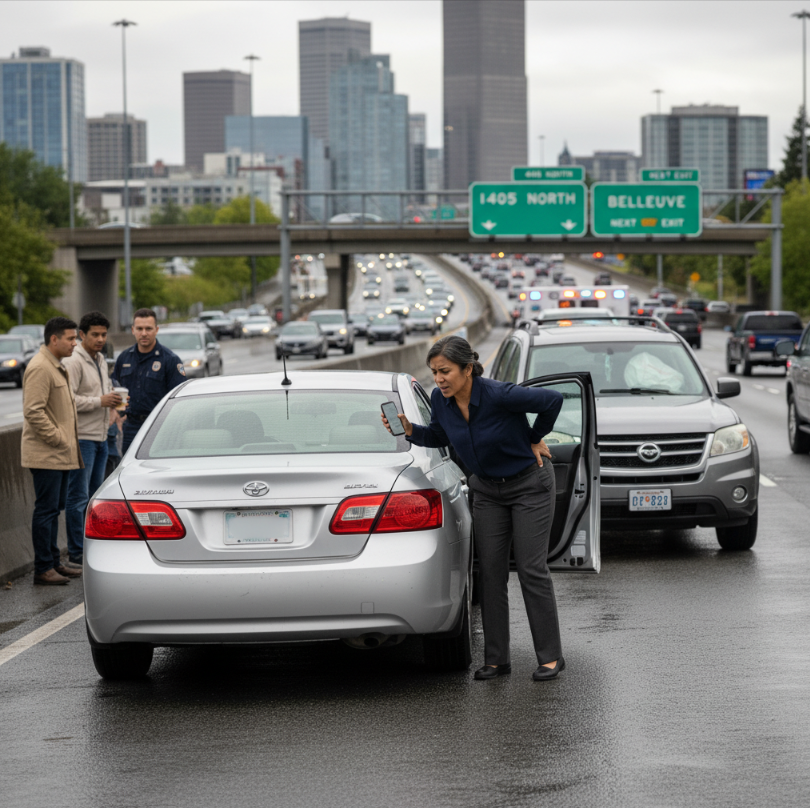
Why lower back pain following car accident is so common
Your lower back (lumbar spine) supports most of your upper body. During a crash, the spine absorbs intense forces — even at low speeds. Agencies like the NHTSA publish resources explaining how crash forces affect the spine.
Different collision types create different stresses on the lumbar spine. The sudden motions and forces involved can strain muscles and ligaments, damage discs, or compress nerves. Symptoms may not show up right away; many people develop pain within 24–72 hours.
Takeaway: Early evaluation helps connect your pain to the crash and starts the path toward recovery. This is especially important for commuters in Bellevue and nearby Seattle who travel busy corridors daily.
Common Accident Types That Cause Lumbar Injuries
- Rear-End Collisions
Common on congested routes like I‑405 or SR‑520, rear‑ends produce a rapid forward‑and‑back motion of the torso. Whiplash gets attention, but your lower back can also take a significant hit — a frequent source of lower back pain following car accident, particularly after an I‑405 rear‑end collision. - T-Bone or Side-Impact Crashes
These impacts can twist the spine unnaturally, raising the risk of disc injuries and nerve compression. - Head-On Collisions
High‑impact crashes may cause spinal fractures, disc herniations, and permanent nerve damage. - Multi-Vehicle Pileups
Sudden deceleration and secondary impacts can compound lumbar trauma.
Even slow‑speed crashes under 10 mph can cause measurable neck and lumbar injuries. Symptoms can be delayed, so early monitoring is important.
Takeaway: Knowing how the crash happened helps medical providers and lawyers link your injury to the collision.

Common Lower Back Injuries After a Car Accident
Lower back pain is a symptom, not a diagnosis. Identifying the underlying injury guides treatment and legal claims.
Takeaway: A clear diagnosis improves treatment choices and strengthens any legal case.
1. Lumbar Strain or Sprain
- Muscle or ligament overstretching
- Stiffness and spasms
- Pain worsened by movement
- Typically heals within weeks with treatment
2. Herniated or Bulging Disc
- Disc material presses against spinal nerves
- Pain radiates into the legs (sciatica)
- Numbness or tingling
- May require injections or surgery
If you need practical guidance on steps to take to secure compensation after a lumbar disc herniation from a car accident, a documented treatment plan and legal evaluation are essential.
3. Facet Joint Injuries
- Damage to the small stabilizing joints in the spine
- Pain when bending or twisting
- Often misdiagnosed at first
4. Spinal Fractures
- Usually caused by high‑speed crashes
- Severe pain, possible instability
- May require surgical intervention
5. Aggravation of Pre-Existing Conditions
Many adults over 40 have degenerative disc disease. A collision can activate previously asymptomatic issues — and Washington law allows compensation for aggravation of existing conditions.
👉 Need help understanding your legal rights? Visit our Bellevue injury attorney page.
Takeaway: Even if you had prior back issues, the accident could have made them significantly worse — and that matters legally.
Key Legal Issues for Lower Back Injury Victims in Washington
1. The 3-Year Statute of Limitations
Under RCW 4.16.080, you generally have three years from the date of the accident to file a personal injury lawsuit in Washington.
Miss that deadline — and you may lose your right to compensation. Waiting is risky: evidence fades, witnesses forget details, and insurance companies move fast.
Takeaway: Acting sooner preserves your rights and the strength of your case.
2. Washington’s Pure Comparative Negligence Rule
Under RCW 4.22.005, Washington follows a pure comparative fault system.
- You can recover damages even if partially at fault.
- Your compensation is reduced by your percentage of fault.
Example: If your total damages are $200,000 and you’re found 20% at fault, you can still recover $160,000.
Takeaway: Even partial responsibility doesn’t eliminate recovery — but it affects the amount.
3. No Cap on Pain and Suffering Damages
Washington does not cap non‑economic damages in car accident cases. That matters for victims with chronic lower back pain that limits daily life.
Takeaway: Compensation can reflect the true impact of ongoing pain and life changes.
Real-World Example: A Bellevue Rear-End Crash
Consider a common scenario:
A Bellevue commuter is rear‑ended on I‑405 during rush hour. At first, she feels only mild soreness. Two days later, she develops severe lower back pain radiating into her leg. An MRI reveals a lumbar disc herniation.
She undergoes:
- 4 months of physical therapy
- Epidural steroid injections
- Misses 6 weeks of work
Total medical expenses: $38,000
Lost wages: $12,000
Because Washington allows recovery for both economic and non‑economic damages, her claim may include compensation for:
- Medical bills
- Future treatment
- Lost income
- Pain and suffering
- Reduced quality of life
Insurance initially offers $25,000 — far below documented damages. After legal representation and negotiation, the settlement significantly increases.
This is a common pattern in King County cases.
👉 Ready to speak with an attorney? Schedule a consultation with R Martin Law Group today.
Takeaway: Documented treatment and experienced representation often make the difference between a low initial offer and full compensation. Residents in Kent may face similar issues when commuting on the same corridors.
How Insurance Companies Handle Lower Back Injury Claims
Insurance adjusters are trained to minimize payouts. Lower back injuries are often targeted because they’re harder to “prove” than visible injuries.
Takeaway: Knowing common tactics helps you avoid mistakes that reduce your recovery.
Common Insurance Tactics
- Claiming the injury is pre‑existing
- Arguing treatment was excessive
- Delaying investigations
- Requesting recorded statements
- Using low settlement multipliers
The Multiplier Method
Insurers often calculate pain and suffering using a multiplier:
Economic damages × 1.5 to 5
| Category | Amount |
|---|---|
| Medical Bills | $20,000 |
| Lost Wages | $10,000 |
| Total Economic | $30,000 |
| Multiplier (3x) | $90,000 |
| Estimated Settlement | $120,000 |
However, this formula is only a starting point. Severe or permanent lumbar injuries often justify much higher valuations.
👉 Injured in Bellevue? Contact R Martin Law Group today for a free consultation.
Takeaway: Don’t let an insurer’s quick math define the value of long‑term pain and disability.
Risks of Delaying Medical or Legal Action
Lower back injuries can worsen without proper care.
Medical Risks
- Chronic pain development
- Nerve damage
- Muscle atrophy
- Reduced mobility
- Long‑term disability
Legal Risks
- Gaps in treatment weaken credibility
- Lost evidence
- Missed deadlines
- Reduced settlement leverage
Insurance companies often argue:
“If you were really hurt, you would have gone to the doctor immediately.”
Even if pain seemed minor at first, seeking medical evaluation protects both your health and your claim.
Takeaway: Prompt medical care safeguards recovery and preserves your legal options.
Steps to Take After Experiencing Lower Back Pain
✅ Immediate Checklist for Accident Victims
| Step | Why It Matters |
|---|---|
| Seek Medical Evaluation | Creates documentation linking injury to accident |
| Follow Treatment Plan | Demonstrates injury seriousness |
| Report the Accident | Required under WA law for injury crashes |
| Document Symptoms Daily | Supports pain & suffering claims |
| Preserve Evidence | Photos, repair records, witness info |
| Consult an Attorney | Prevents costly insurance mistakes |
If you’re wondering how to document and report lower back pain following an I-405 rear-end collision, start with dated symptom journals, treatment records, and photos from the scene — and report the crash to law enforcement as required.
Takeaway: A clear, consistent record of care and evidence builds credibility and value for your claim.
Types of Compensation Available
Lower back injuries often result in both short‑term and long‑term losses.
Economic Damages
- Emergency room visits
- MRI and imaging
- Physical therapy
- Chiropractic care
- Pain management injections
- Surgery
- Lost wages
- Reduced earning capacity
Non-Economic Damages
- Physical pain
- Emotional distress
- Loss of enjoyment of life
- Sleep disruption
- Inability to exercise or participate in hobbies
In catastrophic cases involving paralysis or permanent impairment, settlements can reach hundreds of thousands — sometimes millions — depending on severity. If you’re researching average settlement amounts for chronic lower back pain after a Bellevue car accident, know that values vary widely based on medical records, disability, and fault allocation.
👉 Need help understanding your legal rights? Visit our Bellevue injury attorney page.
Takeaway: Compensation can cover medical needs and the real, everyday losses caused by persistent back pain.
Frequently Asked Questions (FAQ)
1. How long does lower back pain last after a car accident?
Mild lumbar strains may resolve in 2–6 weeks. Disc injuries or nerve damage can last months or become permanent without proper treatment. If you’re asking how long does lower back pain last after a car accident in Bellevue, the answer depends on diagnosis and treatment timeliness.
Takeaway: Early diagnosis and consistent treatment improve the odds of recovery.
2. Can I recover compensation if I had prior back problems?
Yes. Washington law allows compensation for the aggravation of pre‑existing conditions. The key issue is how much the accident worsened your condition.
Takeaway: Prior problems don’t automatically bar recovery — they can be part of the claim.
3. Should I accept the insurance company’s first settlement offer?
Rarely. Initial offers are often significantly lower than the claim’s true value. Consulting an attorney before accepting any offer is strongly recommended.
Takeaway: A lawyer can help ensure an offer reflects your full losses.
4. What if my MRI doesn’t show a herniated disc?
Soft tissue injuries like lumbar strains may not appear clearly on imaging. Pain and functional limitations are still compensable when properly documented.
Takeaway: Lack of imaging findings doesn’t mean your pain isn’t real or compensable.
5. How much is my lower back injury case worth?
It depends on: severity of injury, length of treatment, lost income, insurance policy limits, long‑term impairment, fault allocation. Minor cases may settle in the thousands; serious disc or surgical cases may reach six figures or more.
Takeaway: Case value varies widely; an experienced evaluation helps set realistic expectations.
6. What if the at-fault driver only has minimum insurance?
Washington requires minimum bodily injury coverage of $25,000 per person and $50,000 per accident. If damages exceed that, you may pursue Underinsured Motorist (UIM) coverage or the personal assets of the driver (if available).
Takeaway: Multiple avenues may exist when the at‑fault driver’s policy is insufficient.
Protecting Your Health and Your Future
Lower back pain following car accident is not something to ignore. What starts as soreness can evolve into chronic pain that affects your ability to work, exercise, or spend time with family.
Washington’s three‑year statute of limitations provides time — but building a strong case requires early action, proper documentation, and strategic legal guidance. R Martin Law Group has helped Bellevue and King County injury victims pursue the full compensation they deserve. With deep knowledge of Washington personal injury law and local court systems like the King County Superior Court, the firm provides compassionate, aggressive representation when it matters most.
Takeaway: Protect your health first, and preserve your legal rights early — the two go hand in hand.
Conclusion
Lower back injuries after car accidents are common — but they are never “minor” when they affect your daily life. From lumbar strains to herniated discs and nerve damage, these injuries can carry lasting consequences.
Understanding:
- Your medical options
- Washington’s 3‑year filing deadline
- Comparative fault rules
- Insurance company tactics
- Your right to full compensation
can make the difference between a quick, undervalued settlement and meaningful financial recovery. If you or a loved one is suffering from lower back pain after a car accident in Bellevue, don’t navigate the process alone.
If you’re searching for what evidence do I need to prove a lower back injury after a Bellevue car crash, gather timely medical records, imaging, treatment notes, symptom journals, witness statements, and photos from the scene to support your claim.
👉 Ready to speak with an attorney? Schedule a consultation with R Martin Law Group today.