When you’ve just been in a car accident in Bellevue or anywhere in King County, one of the first questions that comes to mind is: “Who is at fault?”
Understanding car accident determining fault by location of damage issues is critical after a crash. Many drivers assume the answer is obvious just by looking at their vehicles. Rear bumper crushed? The other driver must be responsible. Damage to the side door? Maybe someone ran a red light.
In Washington State, though, determining fault isn’t always that simple.
The location of vehicle damage is an important clue—but it is only one piece of the puzzle. Insurance companies, police officers, and courts combine physical evidence, traffic laws, witness statements, and Washington’s pure comparative fault system to assign responsibility.
If you’ve been injured in Bellevue or nearby Seattle, understanding how fault is determined can directly affect your medical bills, lost wages, and long-term recovery.
When discussing car accident determining fault by location of damage, the key concept is that the point of impact helps reconstruct how the collision occurred.
Investigators use damage patterns to help answer the common question: how is fault determined by location of vehicle damage in Washington State?
Here’s why damage location matters:
It helps determine which vehicle struck the other
It may show right-of-way violations
It can reveal speed, angle, and braking patterns
It may support (or contradict) driver statements
However, Washington law does not assign fault based solely on where damage appears. Instead, vehicle damage location is used as one piece of evidence to determine fault in Washington State—alongside statutes, roadway conditions, and witness accounts.
When handled properly, that broader body of evidence can significantly strengthen your injury claim.
Common Accident Scenarios & What Damage Patterns Suggest
Below are typical ways damage location is interpreted in common Bellevue-area crashes, including incidents throughout King County and neighboring communities like Kirkland and Renton.
1. Rear-End Collisions (Front-End Damage vs. Rear Bumper Damage)
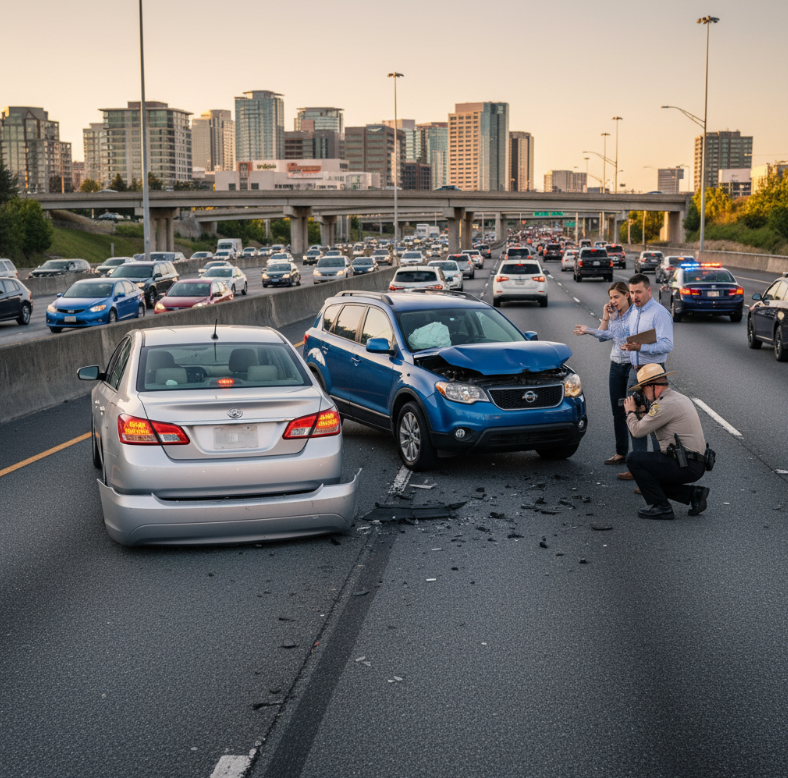
Rear-end crashes are among the most common accidents in King County, especially on congested roadways like I-405 and I-90.
Typical damage pattern:
Front-end damage to the following vehicle
Rear bumper damage to the lead vehicle
In most cases, the rear driver is presumed at fault for:
Following too closely
Speeding
Distracted driving
Failing to brake in time
Washington courts generally assume drivers must maintain a safe following distance under RCW 46.61.145.
However, exceptions exist:
The lead driver suddenly reversed
Brake lights were not functioning
The lead vehicle made an illegal stop
This is where disputes arise. Many injured drivers ask: what evidence defeats an insurer’s fault argument when bumper damage looks minor?
The answer may include:
Skid mark analysis
Event Data Recorder (EDR) downloads
Surveillance footage
Witness statements
Damage alone does not end the inquiry.
2. T-Bone (Side-Impact) Collisions
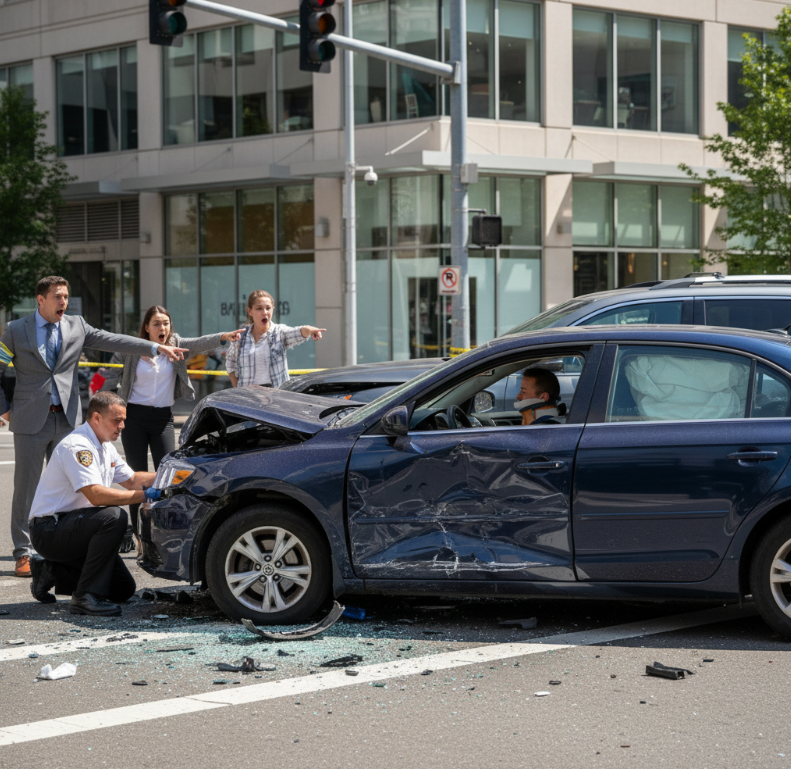
Side damage—especially to doors—often suggests a failure to yield.
Common causes in Bellevue intersections include:
Running a red light
Failing to yield on a left turn
Ignoring stop signs
If Vehicle A has front-end damage and Vehicle B has driver-side door damage, it may indicate Vehicle A struck B while B was crossing or turning.
But disputing insurance liability based on bumper or door damage in King County often requires deeper investigation.
Investigators examine:
Traffic signal timing
Surveillance footage
Witness accounts
Intersection diagrams
If damage location contradicts driver statements, the role of accident reconstruction and event data recorder evidence when damage location contradicts statements becomes especially important. Reconstruction experts can determine speed, braking, and steering inputs seconds before impact.
Damage along the sides of both vehicles may suggest:
Unsafe lane changes
Failure to check blind spots
Merging errors
On highways like SR-520 or I-405, sideswipe crashes are common during heavy traffic merges affecting drivers from Bellevue to Mercer Island.
Determining fault requires answering:
Which vehicle left its lane?
Were turn signals used?
Did one vehicle drift due to distraction?
The scrape pattern and paint transfer help experts determine direction and angle of impact. This analysis plays a central role in car accident determining fault by location of damage cases.
4. Head-On Collisions
Front-end damage to both vehicles often indicates a head-on crash, which can be catastrophic.
Investigators analyze:
Which vehicle crossed the center line
Whether impairment or distraction was involved
Road conditions
In these cases, skid marks and black box data often matter more than visible crush damage. Again, vehicle damage location is just one piece of evidence to determine fault in Washington State.
Washington’s Pure Comparative Fault System
Washington follows a pure comparative negligence rule under RCW 4.22.005.
This means:
Each driver is assigned a percentage of fault.
You can recover damages even if you are partially responsible.
Your compensation is reduced by your share of fault.
Example:
If your damages total $200,000 and you are found 25% at fault, you can still recover $150,000.
Accurate fault analysis is essential because insurance companies frequently argue shared blame based primarily on vehicle damage patterns.
Many clients ask: how do insurance companies use damage location to assign fault in Bellevue crashes?
Insurance adjusters closely examine:
Vehicle repair estimates
Photographs
Police collision reports
Event Data Recorder (EDR) downloads
Body shop analysis
But insurers are not neutral investigators. Their goal is to reduce payouts.
They may argue:
The angle of impact shows you merged improperly
Damage placement suggests shared responsibility
Minimal bumper damage means a low-speed impact—even when injuries are serious
In communities throughout King County, including Redmond and Issaquah, we often see insurers minimizing claims based on superficial vehicle damage.
An experienced personal injury attorney can challenge these interpretations with expert reconstruction testimony and technical data.
The Role of Police Reports in King County
Law enforcement officers document:
Diagram of crash scene
Statements from drivers
Initial fault impressions
Citations issued
Police reports are influential but not legally binding. Insurance companies may accept or dispute an officer’s conclusions.
If damage location contradicts a driver’s story, officers may adjust their assessment. Preserving scene evidence and witness information is critical when disputing insurance liability based on bumper or door damage in King County.
Real-World Example: Bellevue Intersection Crash
Imagine this scenario:
A driver traveling north on Bellevue Way enters an intersection. Another vehicle traveling east collides with the driver’s side door.
Damage pattern:
Side-door crush on Vehicle A
Front bumper damage on Vehicle B
At first glance, Vehicle B appears at fault.
But suppose:
Vehicle A ran a red light
Surveillance footage confirms it
Witnesses corroborate
In that case, damage location alone does not determine liability. This example illustrates how car accident determining fault by location of damage requires a full evidentiary review—not assumptions.
👉 Injured in Bellevue? Contact R Martin Law Group today for a free consultation.
Risks of Relying Only on Damage Location
Relying solely on visible vehicle damage can be misleading because:
Modern bumpers absorb impact differently
High-speed crashes can produce unexpected crush patterns
Secondary impacts may distort evidence
Prior repairs can confuse analysis
Also, injury severity does not always match visible damage.
Low-speed crashes can still cause:
Whiplash
Herniated discs
Traumatic brain injuries
Insurance companies frequently attempt to defeat claims by arguing that minor bumper damage equals minor injury. Strong medical documentation and expert analysis are often necessary to counter this tactic.
Delays and Legal Complications
If fault is disputed, you may face:
Delayed medical bill payments
Extended insurance negotiations
Requests for recorded statements
Comparative fault reductions
Washington’s statute of limitations for most personal injury cases is three years from the date of the accident under RCW 4.16.080.
Waiting too long can jeopardize your claim.
What Victims Should Do After a Crash
To protect your rights after a Bellevue crash:
Call 911 and request a police report
Photograph all vehicle damage and the surrounding area
Gather witness contact information
Seek immediate medical care
Avoid admitting fault
Consult a personal injury attorney before speaking extensively with insurance adjusters
These steps preserve critical evidence used in determining fault by location of damage and other factors.
If another driver is primarily at fault, you may recover:
Medical expenses (current & future)
Lost wages
Reduced earning capacity
Pain and suffering
Property damage
Rehabilitation costs
If you are partially at fault, your recovery is reduced proportionally under Washington’s comparative negligence system.
Frequently Asked Questions
1. Can fault be determined just by looking at vehicle damage?
No. While damage location helps reconstruct an accident, investigators rely on traffic laws, witness statements, video footage, and electronic vehicle data.
2. What if both vehicles have front-end damage?
That may indicate a head-on collision, but fault depends on who crossed into the wrong lane or violated traffic rules.
3. Does Washington follow no-fault insurance rules?
No. Washington is a fault-based state. The at-fault driver’s insurance is responsible for damages.
4. What happens if I am partially at fault?
Under Washington’s pure comparative negligence rule, you can still recover damages, but your compensation is reduced by your percentage of fault.
5. Can insurance companies misinterpret damage patterns?
Yes. Adjusters may interpret damage in a way that reduces their liability. Accident reconstruction experts can challenge inaccurate conclusions.
6. How long do I have to file a car accident claim in Washington?
Generally, you have three years from the accident date to file a personal injury lawsuit.
Why Legal Representation Matters
Determining fault by location of damage may seem straightforward—but it rarely is.
Insurance companies have teams working to protect their bottom line. You deserve someone protecting yours.
R Martin Law Group represents car accident victims throughout Bellevue and King County. Our firm understands Washington’s comparative fault system and the tactics insurers use to shift blame based on vehicle damage patterns.
We work with:
Accident reconstruction specialists
Medical experts
Economic loss analysts
Our goal is simple: maximize your recovery while you focus on healing.
Damage Location Is a Clue—Not the Final Answer
The location of vehicle damage provides valuable insight into how a crash occurred—but it does not automatically determine fault in Washington State.
In any car accident determining fault by location of damage analysis, true liability depends on:
Traffic law violations
Negligence
Scene evidence
Comparative fault principles
If you’ve been injured in a Bellevue car accident and fault is being disputed, don’t rely on assumptions or insurance company interpretations.