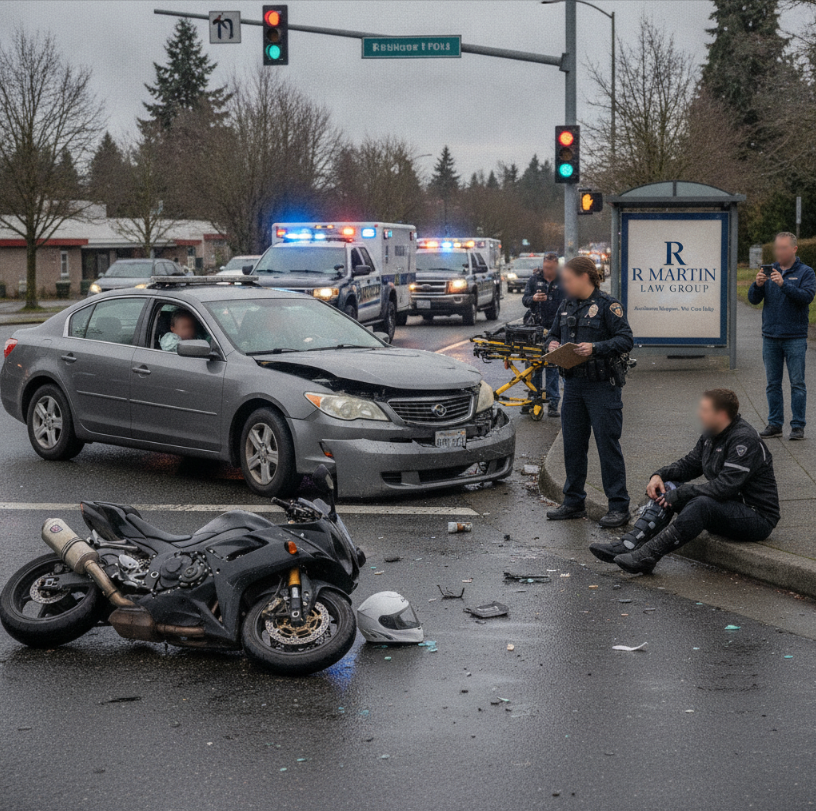
Motorcycle accidents are among the most devastating collisions on Washington roads. Riders have little physical protection, and even a low-speed crash can produce life-altering injuries. Beyond the physical pain and emotional trauma, many injured motorcyclists in Bellevue and across King County face another serious concern: understanding Washington comparative negligence motorcycle rules and how they affect recovery.
What if the insurance company says the crash was partly my fault?
This is where Washington’s comparative negligence law matters most.
Under Washington law, you can still recover compensation after a motorcycle accident — even if you were partially at fault. However, your recovery will be reduced by your percentage of fault.
Knowing how this works can mean the difference between a fair settlement and walking away with far less than you deserve.
If you or a loved one has been injured in a motorcycle crash, this guide explains:
How Washington’s comparative negligence law works
How fault is assigned in motorcycle accidents
How insurance companies use comparative fault against riders
What evidence matters most
How Bellevue injury victims can protect their rights
Washington Is a “Pure Comparative Negligence” State
Washington follows a pure comparative negligence rule under RCW 4.22.005.
Washington comparative negligence motorcycle: the pure comparative rule
This means:
An injured person may recover damages even if they are 99% at fault — but their compensation is reduced by their percentage of fault.
How It Works in a Motorcycle Case
Let’s say:
Your total damages equal $200,000
A jury finds you 25% at fault
The other driver is 75% at fault
You can still recover:
$200,000 − 25% = $150,000
Even if you were found 60% at fault, you could still recover 40% of your damages.
This differs from “modified comparative negligence” states, where victims cannot recover anything if they are 50% or 51% at fault.
Washington’s system is more favorable to injured riders — but insurance companies aggressively fight over fault percentages.
👉 Injured in Bellevue? Contact R Martin Law Group today for a free consultation.
Why Motorcycle Riders Are Often Blamed
Motorcyclists frequently face unfair bias after a crash. Insurance adjusters may argue that riders were:
Speeding
Lane splitting
Driving aggressively
Taking unnecessary risks
Failing to wear proper safety gear
Even when a car driver caused the crash, insurers may try to shift partial blame onto the rider to reduce payouts. This explains in part why insurance companies frequently target riders with aggressive fault arguments — and why understanding why insurance companies blame motorcyclists after Bellevue collisions matters when building your case.
While every crash is unique, common causes include:
Left-turn collisions at intersections
Drivers failing to yield
Distracted driving
Unsafe lane changes
Rear-end collisions
Impaired drivers
Poor road conditions
Recent Washington traffic safety reports (see WSDOT) show that motorcycle riders account for a disproportionate share of serious and fatal crashes compared to their numbers on the road.
King County — including Bellevue — sees heavy commuter traffic on I-405, I-90, and SR-520, increasing the chance of multi-vehicle interactions where fault disputes arise. Riders in nearby Seattle also face similar risks during rush hours.
Key Legal Issues in Washington Motorcycle Comparative Fault Cases
Understanding how comparative negligence applies requires looking at several legal principles.
Each party is responsible only for their percentage of fault.
If you’re wondering how to challenge comparative negligence percentage in Washington motorcycle accident cases, preserving evidence and using expert reconstruction are central strategies.
2. Helmet Use and Comparative Negligence
Washington requires motorcycle helmets that meet DOT standards. If a rider fails to wear a compliant helmet, insurers may argue that the lack of a helmet increased the severity of head injuries — potentially reducing damages for those head injuries while leaving unrelated injuries unaffected.
3. Lane Splitting Is Illegal in Washington
Unlike California, Washington does not permit lane splitting. If a crash occurs while a rider is traveling between lanes, insurers may argue negligence. Still, fault depends on the full circumstances of the collision.
A motorcyclist is traveling eastbound through a Bellevue intersection on a green light. A vehicle turns left in front of the rider. The motorcyclist is traveling 8 mph over the speed limit.
The crash results in:
Broken femur
Concussion
$120,000 in medical expenses
$40,000 in lost wages
Total damages: $200,000
At trial, the jury determines:
Car driver: 80% at fault
Motorcyclist: 20% at fault (for speeding)
The rider recovers:
$200,000 × 80% = $160,000
Without proper legal representation, the insurance company might have argued the rider was 50% at fault — reducing recovery to $100,000.
The difference? $60,000.
Fault percentages matter tremendously.
How Insurance Companies Use Comparative Negligence Against Riders
Insurance companies aim to minimize payouts. In motorcycle cases, they often:
Request recorded statements quickly
Look for admissions of speeding
Review social media
Analyze riding gear
Question visibility
Hire accident reconstruction experts
Their goal: assign you a higher percentage of fault.
If you want to know what evidence reduces your percentage of fault in Bellevue motorcycle crash claims, focus on medical records, witness statements, helmet and gear preservation, scene photos, and expert analysis.
Common Adjuster Tactics
“You were going a little fast, right?”
“Motorcycles are harder to see — maybe you were in their blind spot?”
“Were you weaving through traffic?”
Even minor statements can later be used to argue shared fault. That’s why early legal guidance is critical.
Motorcycle injuries often include traumatic brain injuries, spinal cord damage, and multiple fractures. Higher damages mean insurers fight harder to reduce their share.
3. Washington’s Statute of Limitations
In most personal injury cases in Washington, you have three years from the date of the accident to file a lawsuit. See King County court rules for local procedures.
Delaying action can weaken evidence, make witnesses harder to locate, and strengthen the insurer’s position.
What Compensation Can Be Reduced by Comparative Fault?
Comparative negligence applies to nearly all categories of damages. Below is a breakdown:
Type of Compensation
Reduced by Comparative Fault?
Examples
Medical Expenses
Yes
ER visits, surgery, rehab
Lost Wages
Yes
Missed work, reduced earning capacity
Pain and Suffering
Yes
Physical pain, emotional trauma
Property Damage
Yes
Motorcycle repair or replacement
Future Medical Costs
Yes
Long-term therapy, surgeries
If you are found 30% at fault, every category above is reduced by 30%.
Practical Steps to Protect Yourself After a Motorcycle Crash
Taking the right steps early can significantly affect how fault is assigned. These are the key steps to protect recovery and follow the steps to protect your rights after a Bellevue motorcycle crash when partly at fault.
✅ At the Scene
Call 911
Seek medical attention
Document the scene with photos
Get witness contact information
Avoid admitting fault
✅ In the Days After
Follow all medical advice
Keep detailed records
Avoid posting about the accident online
Contact a personal injury attorney
✅ Before Speaking to Insurance Adjusters
Do not give a recorded statement without legal advice
Do not accept early settlement offers
Do not speculate about speed or fault
If you need to learn how to challenge comparative negligence percentage in Washington motorcycle accident proceedings, early preservation of evidence and skilled negotiation or litigation are essential.
👉 Injured in Bellevue? Contact R Martin Law Group today for a free consultation.
How R Martin Law Group Helps Bellevue Motorcycle Accident Victims
Motorcycle accident litigation requires:
Knowledge of Washington comparative fault law
Experience countering rider bias
Access to accident reconstruction experts
Strong negotiation skills
R Martin Law Group understands the unique dynamics of King County traffic, local court procedures, and insurance company tactics. The firm represents riders throughout Bellevue and nearby Redmond, fighting to reduce unfair fault allocations and maximize recovery.
When fault percentages determine thousands — or hundreds of thousands — of dollars, experienced legal representation matters.
Motorcycle Comparative Negligence Claim Checklist
Step
Completed?
Seek immediate medical care
⬜
Obtain police report
⬜
Photograph injuries and motorcycle damage
⬜
Preserve helmet and riding gear
⬜
Avoid recorded insurance statement
⬜
Consult Bellevue motorcycle accident attorney
⬜
Track all medical expenses
⬜
Document missed work and income loss
⬜
Frequently Asked Questions About Washington Comparative Negligence & Motorcycle Accidents
1. Can I still recover damages if I wasn’t wearing a helmet?
Yes. Washington’s pure comparative negligence system allows recovery even if you share fault. However, failure to wear a helmet may reduce compensation for head injuries specifically.
2. What if I was speeding slightly when the crash happened?
Speeding does not automatically bar recovery. A jury may assign a percentage of fault based on how much the speeding contributed to the crash.
3. How is fault determined?
Fault is determined through:
Police reports
Witness statements
Accident reconstruction
Traffic camera footage
Expert testimony
4. Can both drivers be mostly at fault?
No. Fault percentages must total 100%. However, multiple parties can share varying degrees of responsibility.
5. How long do I have to file a motorcycle accident lawsuit in Washington?
Generally, three years from the date of the accident. Exceptions may apply in limited circumstances.
6. Will my case automatically go to court if fault is disputed?
Not necessarily. Many comparative negligence disputes are resolved through negotiation. However, strong trial preparation often improves settlement leverage.
Don’t Let Comparative Fault Reduce Your Future
Motorcycle accidents are traumatic enough without facing insurance companies determined to shift blame. Understanding how Washington pure comparative negligence affects motorcycle injury settlements is essential to protecting your recovery.
Even a 10% difference in assigned fault can mean tens of thousands of dollars in compensation.
If you were injured in a Bellevue motorcycle accident:
Do not assume you cannot recover
Do not accept the insurer’s first fault determination
Do not navigate the system alone
R Martin Law Group is committed to protecting the rights of injured riders throughout Bellevue and King County. With experienced advocacy and a deep understanding of Washington comparative negligence motorcycle law, the firm works to ensure fault is fairly assigned — and compensation fully pursued.