
Nothing protects a person on foot. When a car hits someone walking, the injuries are almost always serious: broken bones, head injuries, and long months of recovery. Rich Martin is a Washington pedestrian accident lawyer who has spent 28 years representing injured people. His results for pedestrians include a $9 million settlement after a semi-truck hit a pedestrian and a $1.05 million jury verdict for a pedestrian with a brain injury.
Past results don’t guarantee future results. Every case is different. Here’s what Washington law says about people on foot, and what to do if it happened to you or someone you love.

Pedestrian deaths in Washington
People walking killed in Washington traffic crashes
2023 was the worst year on record for people on foot in Washington. The count has dropped since, but only a little. The state’s traffic safety agency also reports that half of the people killed while walking or rolling died in just two counties, King and Pierce (WTSC). Both of our offices are in those two counties.
Who has the right of way
Many people think pedestrians always have the right of way. Washington law is more specific than that. The rules decide a lot about fault.
| Situation | What the law says | Law |
|---|---|---|
| In a marked or unmarked crosswalk | Drivers must stop and stay stopped while you’re in their half of the road, or within one lane of it | RCW 46.61.235 |
| A car ahead has stopped for you | Other drivers may not pass that stopped car | RCW 46.61.235 |
| At a corner with no paint | It’s still a crosswalk. The sidewalk lines extend across the street | RCW 46.04.160 |
| Crossing mid-block, outside a crosswalk | You must yield to cars | RCW 46.61.240 |
| Any time | Drivers must use due care to avoid hitting a pedestrian | RCW 46.61.245 |
| No sidewalk | Walk on the shoulder, facing traffic, as far from the road as you can | RCW 46.61.250 |
The unmarked crosswalk rule surprises people. Every corner where sidewalks meet counts, even without stripes. Drivers who don’t stop there are breaking the law.
Crossing outside a crosswalk doesn’t end your case
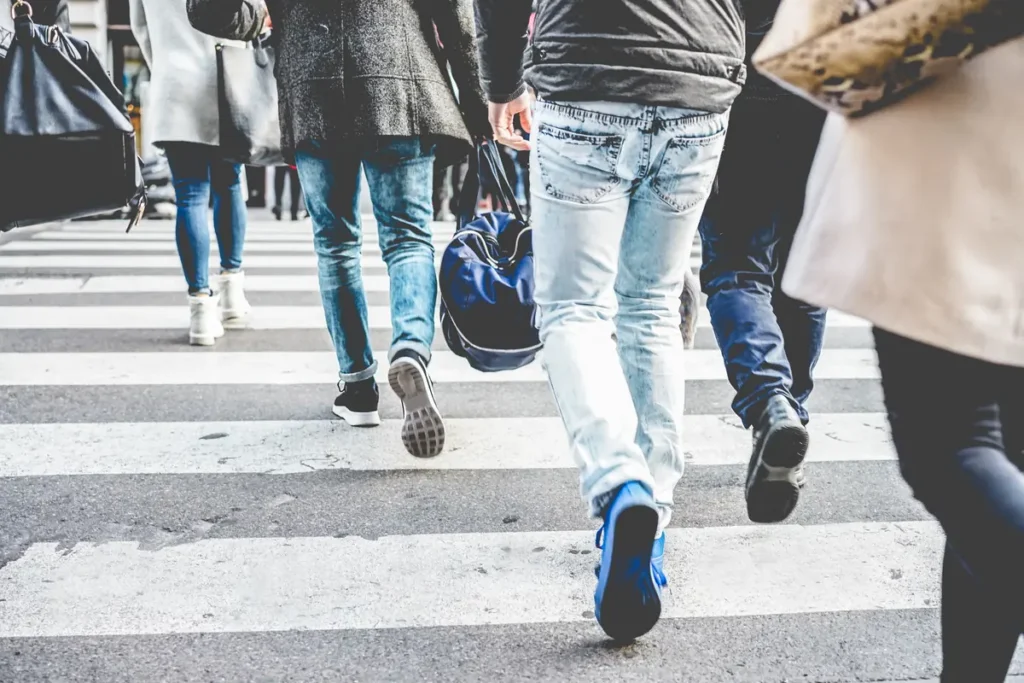
Insurers love to say, “He wasn’t in the crosswalk.” Even if that’s true, drivers still have to watch for people and use care (RCW 46.61.245). Washington’s comparative fault rule then splits the blame (RCW 4.22.005). If you were 30% at fault, you can still recover 70% of your losses.
Shared fault after a mid-block crossing
Your own car insurance can cover you on foot
This is one of the most overlooked rules in Washington. You don’t have to be in a car to use your auto policy. PIP covers you as a pedestrian hit by a car (RCW 48.22.005; RCW 48.22.085). Your UIM coverage can pay if the driver had too little insurance or none (RCW 48.22.030).
- Your PIP pays medical bills and some lost wages early, no matter who was at fault.
- The driver’s liability insurance pays for the full loss, usually at settlement.
- Your UIM fills the gap when the driver’s coverage runs out.
- Your health insurance covers what’s left in the meantime.
Hit-and-run? UIM can still apply, but the law requires a report to police within 72 hours (RCW 48.22.030). Report it right away, even if you’re still in the hospital. A family member can call.
Where people on foot get hurt
- Left turns at signals, when a driver watches oncoming cars and misses the person in the crosswalk.
- Right turns on red, when a driver looks left and rolls forward.
- Parking lots and driveways, especially cars backing out.
- Bus stops and transit stations, with people crossing to make a connection.
- Dark, rainy evenings, when dark clothes and glare make people hard to see.
- Roads without sidewalks, where people walk on the shoulder.
Read about the main causes of pedestrian accidents.
Injuries that change lives
A person on foot takes the full force of the car, then hits the pavement. Common injuries include:
- Brain injuries, which may not show on day one.
- Broken legs, hips, and pelvis, often needing surgery.
- Spine and neck injuries.
- PTSD and anxiety, including fear of crossing the street again.
The emotional injury can be just as heavy as the physical one. In one case, a pedestrian was left with PTSD, and the case settled in mediation for $600,000. In another, a pedestrian broke bones, and the case settled for the policy limits, $750,000. Past results don’t guarantee future results.
What to do after a pedestrian accident
- Call 911 and get medical care. Injuries to people on foot are often worse than they first seem.
- Get the driver’s name, plate, and insurance. If you can’t, ask someone to do it.
- Find witnesses. People who saw it are the strongest evidence in a crosswalk case.
- Photograph the scene: the crosswalk, signals, lighting, and where the car ended up.
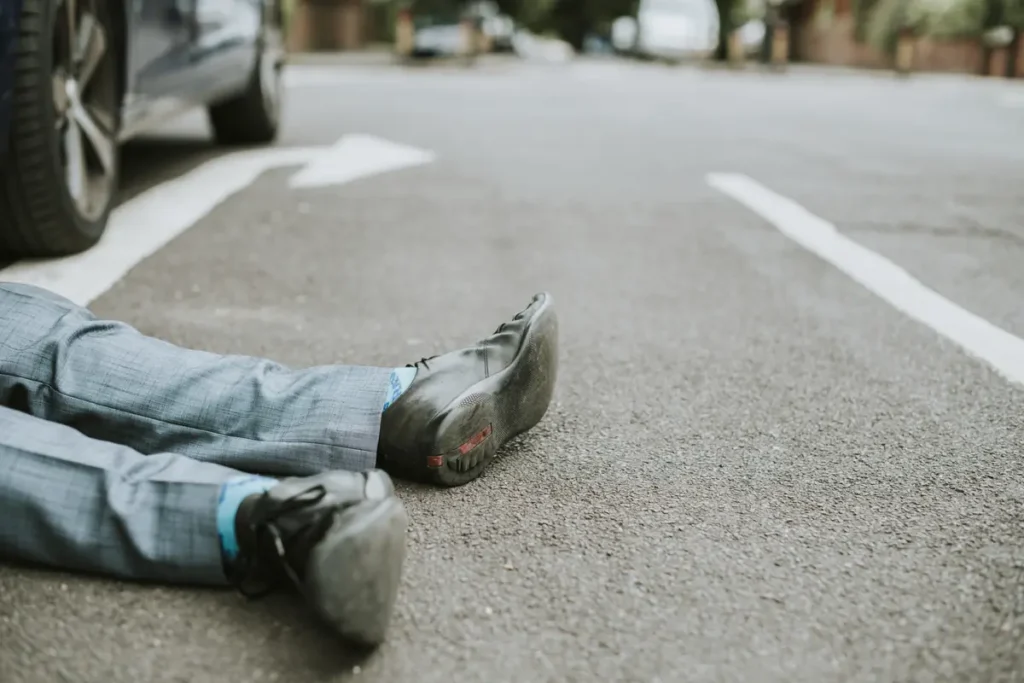
- Keep your shoes and clothing. They can show the point of impact.
- Don’t talk to the driver’s insurer before talking to a lawyer.
See what to do after a pedestrian accident.
Deadlines
Most pedestrian cases must be filed within three years (RCW 4.16.080). If a city bus, a public vehicle, or a dangerous public road played a part, a government claim form comes first, with a 60-day wait (RCW 4.96.020). Sound Transit and King County Metro each have their own claim process. A Washington pedestrian accident lawyer can tell you which deadlines apply. Don’t wait on these.
Pedestrian accident help in your city
Local pages cover pedestrian cases in Seattle, Bellevue, Tacoma, Everett, and Kent: the dangerous corridors, local safety plans, and claim offices.
Talk to a Washington pedestrian accident attorney
You were just walking. Now you’re dealing with injuries, bills, and an insurer. Let us take the insurer. The call is free, and No Win, No Fee means you owe nothing if we don’t win. Call (425) 635-2000 or send us a message.
Pedestrian Accidents: results for our clients
Past results don't guarantee future results. Every case is different. See all results →

Your attorney: Rich Martin
28 years. More than 2,000 injury cases. More than 30 jury trials. When you call, you talk to Rich, and he handles your case himself.
About Rich Martin →Find help in your city
Common questions
What does No Win, No Fee mean?
You pay nothing up front. Our fee comes out of the money we win for you. No hourly bills. No retainer. If we don't win, you owe us nothing. Not even the case costs.
Do pedestrians always have the right of way in Washington?
No. Drivers must stop for people in marked and unmarked crosswalks. Outside a crosswalk, pedestrians must yield. But drivers must always use care to avoid hitting anyone.
Will my car insurance pay if I was hit while walking?
Often, yes. Washington PIP covers you as a pedestrian struck by a car, and your UIM can apply if the driver was uninsured or underinsured.
What if I was hit outside a crosswalk?
You may still recover. Washington uses comparative fault, so your share of blame reduces the recovery but doesn't erase it.
The driver drove away. What now?
Report it to police within 72 hours to protect a UIM claim. Then call us. Hit-and-run cases can still be paid through your own policy.
Do I need a Washington pedestrian accident lawyer?
If you were seriously hurt, it helps. Fault is often disputed, and several policies may apply. A free call can help you decide.
Talk to a lawyer today. The call is free. Call (425) 635-2000.
Helpful articles
What to Do After a Pedestrian Accident
What to do after a pedestrian accident matters from the first moments — and knowing the right steps can protect your health, your legal…
Pedestrian Accident Injuries in Bellevue
Every day in Bellevue and across King County, people walk to work, school, parks, bus stops, and local businesses. Walking should be one of…
Is Jaywalking Legal in WA?
Is Jaywalking Legal in WA? What Bellevue Pedestrians Need to Know If you’ve ever crossed mid‑block in downtown Bellevue, hurried across NE 8th Street…