
Last updated: October 28, 2026
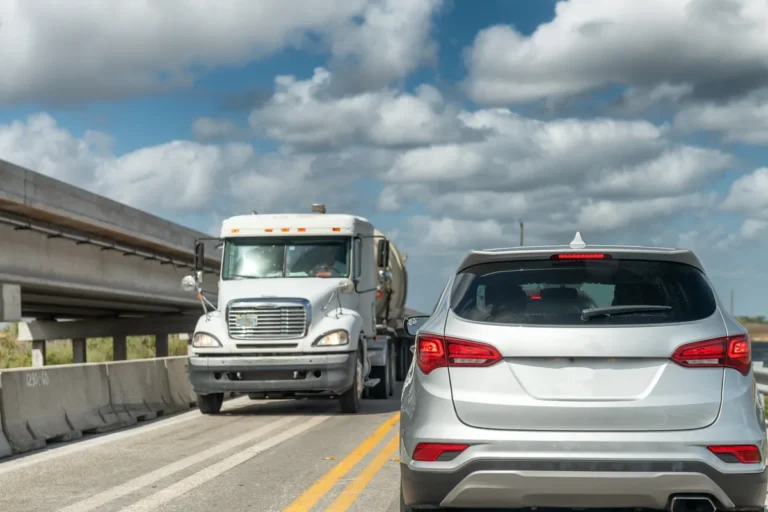
A semi drifted into your lane on I-405 and clipped your car. The driver was apologetic at the scene. Two days later, a claims adjuster for the trucking company calls, friendly and in a hurry, asking for a recorded statement. You’re wondering who you’re actually dealing with.
Who is liable in a truck accident? Often more than one party. The driver may be at fault, but the trucking company is usually responsible for its driver, and it can also be at fault for its own choices. A cargo loader, repair shop, or parts maker can share the blame. Here’s how truck accident liability works in Washington.
The short answer: The driver and the trucking company are the usual defendants. A company is generally responsible for a driver doing the job, and for its own hiring, scheduling, and maintenance. The cargo loader, a repair shop, or a parts maker may share fault. Federal records often prove who owes you.
Who is liable in a truck accident?
Anyone whose carelessness helped cause your crash. That usually starts with the driver and the trucking company. Then it can reach the company that loaded the trailer, a shop that did bad brake work, or the maker of a part that failed. Washington splits fault among everyone responsible, so finding each one can mean more insurance for you.
| Who may be liable | Why | Proof that often shows it |
|---|---|---|
| The driver | Speeding, fatigue, distraction, an unsafe lane change | Logs, phone records, the truck’s electronic data |
| The trucking company | Responsible for its driver; also its own hiring, schedules, and repairs | Driver files, dispatch records, maintenance records |
| The cargo loader | An overweight, unbalanced, or loose load | Bills of lading, loading records, scale tickets |
| A repair shop | Bad brake or tire work | Work orders and inspection reports |
| A parts maker | A defective part that failed | The part itself, recalls, an engineer’s inspection |
| Another driver | Cut off the truck or caused the chain reaction | Witnesses, video, scene photos |
When is the trucking company responsible for the driver?
When the driver was doing the job. Washington holds an employer responsible for a worker’s carelessness within the scope of employment. The Supreme Court frames the test as whether the employee was “fulfilling his or her job functions” at the time. A driver hauling a load on a company run usually is. That’s why the company’s insurer handles your claim.
The test is described in Robel v. Roundup Corp., Washington Supreme Court (2002). A company can also be at fault on its own, which gives you a second path. Federal rules require it to keep a qualification file on every driver, with the application, driving record checks, a road test, and a medical certificate. A missing or ignored record can show careless hiring.
What if the driver owns the truck?
The trucking company may still be responsible. Many drivers own their trucks and lease them to a licensed carrier. Federal rules require that lease to give the carrier exclusive possession, control, and use of the truck. So the carrier whose name and USDOT number are on the door is often the one that answers to you.
Those rules are 49 CFR 376.12 and 49 CFR 390.21. The lease rule doesn’t decide whether the driver is an employee. That question can still matter, so you’ll want a copy of the lease.

Can the company that loaded the cargo be at fault?
Yes, if a bad load helped cause your crash. A heavy, off-balance, or loose load can shift and tip a trailer. Federal rules say a truck can’t be driven unless its cargo is properly spread out and secured, and drivers must recheck it on the road. A sealed trailer points back to whoever loaded it.
The cargo rule is 49 CFR 392.9. Drivers of sealed loads they were told not to open are excused from the inspection, which is why you want the loading records.
Which federal rules help prove who was at fault?
The ones that leave a paper trail you can use. Drivers have limits on how long they can drive. Companies must keep files on who they hired and how they kept trucks running. When a company breaks those rules, the paperwork usually shows it, and a jury can weigh that against them.
| Federal rule | What it requires | Why it matters in a crash |
|---|---|---|
| 49 CFR 395.3 | No more than 11 hours of driving, only after 10 hours off duty; a 30-minute break after 8 hours of driving | Shows whether the driver was too tired |
| 49 CFR 391.51 | A qualification file on each driver, kept 3 years after the driver leaves | Shows whether the company checked who it hired |
| 49 CFR 392.9 | Cargo properly distributed and secured | Points to the loader or the carrier |
| 49 CFR 376.12 | The carrier controls a leased truck during the lease | Ties an owner-operator to the carrier |
What if another driver caused the truck crash?
Then that driver may owe you too. Other motorists cause some truck crashes by cutting in front of a truck that can’t stop in time. If several drivers share the blame, Washington splits fault among them. You can claim against each one. If one has too little insurance, your own UIM coverage may help.
Read how damage location helps show fault and what UIM coverage does.
How much insurance does a truck carry?
More than a car, by federal rule. An interstate for-hire carrier hauling ordinary freight in a truck over 10,000 pounds must carry at least $750,000 in coverage. Carriers of oil need $1 million, and some hazardous materials require $5 million. If your injuries are serious, that coverage matters to you.
Federal minimum insurance for for-hire trucks
What should you do to find out who’s liable?
Save what identifies the truck, and move fast on your records request. Write down the company name and USDOT number on the cab door, plus the trailer’s number. Photograph the scene and get witness names. Don’t give the trucking company’s insurer a recorded statement. Some federal records can lawfully be thrown out, so ask early.
- Photograph the cab door: company name and USDOT number.
- Get the driver’s name, license, and insurance.
- Get a copy of the police report.
- See a doctor, even if you feel okay.
- Send a letter asking the company to keep its records.
When we take a truck case, Rich handles it himself and prepares it for trial from the start. In one case, a tractor-trailer crash caused a disc injury, and a jury returned a $2.0 million verdict. Past results don’t guarantee future results. Every case is different. See how we handle truck accident cases.
FAQ
Can I sue the trucking company and the driver?
Often, yes. You can name both. The company is usually responsible for its driver and may be at fault on its own.
What if I was partly at fault?
You can still recover in Washington. Your payment goes down by your share of fault.
How long do I have to file a truck accident lawsuit?
You generally have three years from the crash in Washington. Claims against a government owner need a claim form first. See the Washington deadline.
Who pays my medical bills while the case is open?
Usually your own PIP coverage first, then your health insurance. The at-fault party’s insurer pays as part of your claim.
What does No Win, No Fee mean?
You pay nothing up front. Our fee comes out of the money we win for you. No hourly bills. No retainer. If we don’t win, you owe us nothing. Not even the case costs.
Talk to Rich about your truck crash
Who is liable in a truck accident? Usually more than the driver, and the records prove it. If a truck hurt you, call Rich Martin. He has handled more than 2,000 injury cases in 28 years and taken more than 30 to a jury. He was named to the National Association of Distinguished Counsel’s Nation’s Top One Percent in 2023 and 2024.
We help people in Bellevue, Seattle, Tacoma, and across Washington. Your case review is free. No Win, No Fee. We speak English and Korean.
Call (425) 635-2000 or see how we handle truck accident cases.
Keep reading

Bellevue Truck Accident Settlement Guide
Truck Accident Settlement in Washington State: What Bellevue Victims Need to Know A collision with a commercial truck can change your life in seconds.…

Truck Jackknife Accidents in Bellevue and Washington State
A fully loaded semi-truck can tip the scales at up to 80,000 pounds. When things go wrong at highway speeds, the results can be…

Why Accidents Involving Commercial Trucks Are Dangerous
Picture this: you’re cruising down the highway, relaxed and enjoying your drive, when suddenly a massive commercial truck drifts too close, or worse—swerves into…