

Last updated: November 18, 2026
A driver turned left in front of you on Bellevue Way, and you went down hard. Your leg is in a brace, your bike is totaled, and you keep thinking about how much worse it could have been. You start looking up the numbers, and every site seems to give a different one.
Here’s the honest answer to what percentage of motorcycle accidents are fatal. No agency counts every motorcycle crash, so no one has an exact share. The closest federal numbers come from 2024. That year, 6,228 riders were killed and an estimated 86,887 were hurt. So about 7 of every 100 riders killed or hurt in a crash died.
The short answer: About 7% of motorcyclists killed or injured in U.S. crashes in 2024 died, by our math from NHTSA counts. Per mile, riders die at almost 27 times the rate of car occupants. In Washington, 113 motorcyclists died in 2024. In 45% of deadly two-vehicle crashes, the other vehicle was turning left.
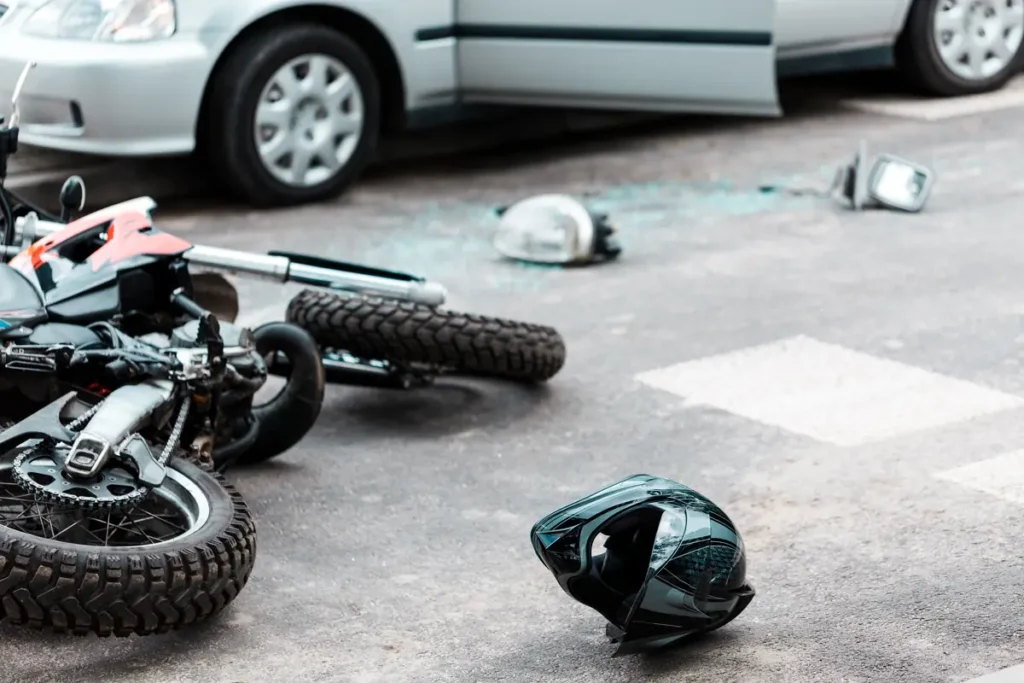
What percentage of motorcycle accidents are fatal?
About 7% of motorcyclists killed or hurt in reported crashes die. In 2024, NHTSA counted 6,228 motorcyclists killed and estimated 86,887 injured. Divide the deaths by the total of 93,115, and you get 6.7%. That means roughly 14 riders were hurt for every rider killed. Crashes where no one was hurt aren’t in that count.
| U.S. motorcycle numbers, 2024 | Value |
|---|---|
| Motorcyclists killed | 6,228 (16% of all traffic deaths) |
| Motorcyclists injured (estimate) | 86,887 |
| Share of killed or injured riders who died | 6.7% (6,228 ÷ 93,115, our math) |
| Deaths per 100 million miles, motorcycles | 28.00 |
| Deaths per 100 million miles, passenger cars | 1.05 |
| Riders in fatal crashes with no valid motorcycle license | 35% |
What percent of motorcycle accidents result in injury or death?
No federal source gives that share, because minor crashes with no injury aren’t counted the same way. What NHTSA does show is risk per mile. In 2024, riders were injured at a rate of 391 per 100 million miles, nearly 5 times the rate for car occupants. They died at almost 27 times the car rate.
Deaths per 100 million vehicle miles, 2024
How common are motorcycle accidents?
If you ride, your share of the risk is far bigger than your share of the road. Motorcycles were 3% of registered vehicles in 2024 and only 0.7% of the miles driven. Yet riders were 16% of everyone killed on U.S. roads. The death count fell 2.2% from 2023, while the injury estimate rose 5.2%.
Those figures are in NHTSA’s 2024 motorcycle fact sheet. Riding season matters too. In 2024, about 46% of riders who died were killed on weekends, which NHTSA counts as Friday 6 p.m. to Monday 6 a.m.
How many motorcyclists die in Washington?
Washington lost 113 motorcyclists in 2024, down from 142 in 2023 and 133 in 2022. The 2024 number is still preliminary in the state’s count. Federal data agree on 113. Of the riders killed in Washington whose helmet use was known, 95% were wearing one. State law requires you to wear one every time you ride.
| Washington motorcyclist deaths | 2022 | 2023 | 2024* |
|---|---|---|---|
| Motorcyclists killed | 133 | 142 | 113 |
| All traffic deaths | 743 | 809 | 731 |
| Motorcyclists’ share | 18% | 18% | 15% |
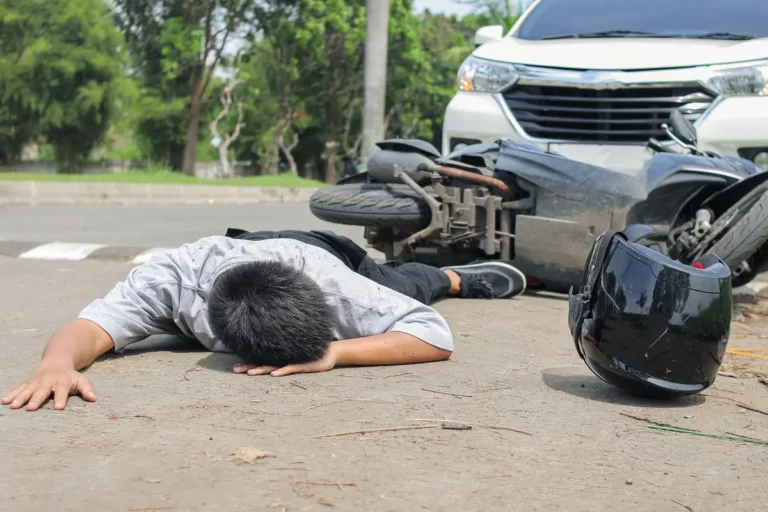
What causes most motorcycle accidents?
In nearly half of deadly crashes between a motorcycle and another vehicle, the other driver was turning left across the rider’s path. That was 45% of the 3,396 two-vehicle fatal motorcycle crashes in 2024. Speed and alcohol matter too. In 2024, 37% of riders in fatal crashes were speeding, and 25% were alcohol-impaired.
| Factor in fatal motorcycle crashes, 2024 | Share |
|---|---|
| Other vehicle turning left while the bike went straight or passed (two-vehicle crashes) | 45% (1,532 of 3,396) |
| Both vehicles going straight (two-vehicle crashes) | 20% (689) |
| Riders speeding | 37% |
| Riders alcohol-impaired | 25% |
| Motorcycles hitting a fixed object | 24% |
| Bikes hit on the front in two-vehicle crashes | 78% |
The left-turn crash is why fault often lands on the car driver. Washington law says a driver turning left must yield to oncoming traffic (RCW 46.61.185).
Where do most motorcycle accidents occur?
Two-thirds happen in urban areas, and nine in ten happen off the interstates. In 2024, 66% of motorcyclist deaths were in urban areas, and 91% were on non-interstate roads. Most weren’t at intersections: 62%. And most happened in daylight (56%) and clear or cloudy weather (97%), not in the rain or dark.
These are national figures based on known values, from the NHTSA fact sheet. For riding safely in Washington’s wet months, read riding a motorcycle in the rain.
What Washington laws protect motorcycle riders?
Several rules matter after a crash. You’re entitled to the full use of a lane, and no driver may crowd you out of it. Lane splitting is illegal. Every rider and passenger must wear a helmet on public roads. And you need a motorcycle endorsement on your license. Breaking these rules can come up when fault is split.
- You get the full use of a lane (RCW 46.61.608(1)).
- You can’t ride between lanes or rows of cars (RCW 46.61.608(3)).
- You must wear a helmet on state highways, county roads, and city streets (RCW 46.37.530(1)(c)).
- You need a motorcycle endorsement to ride (RCW 46.20.500).
- A driver turning left must yield to you when you’re oncoming (RCW 46.61.185).
Read the statutes at RCW 46.61.608, RCW 46.37.530, and RCW 46.20.500. More rules are in 15 Washington motorcycle laws.
Who pays after a motorcycle crash in Washington?
The at-fault driver’s insurance pays, up to its limits. Washington’s minimum is $25,000 per person. If you were partly at fault, your payment goes down by your share but isn’t wiped out. Insurers don’t have to offer riders PIP, so you may not have it. They do have to offer underinsured motorist coverage.
The rules are RCW 46.29.090 and RCW 4.22.005. You generally have three years to file a lawsuit (RCW 4.16.080(2)). Read who pays medical bills after a motorcycle accident and how a motorcycle accident lawsuit works.
When we take a motorcycle case, Rich handles it himself. He studied mechanical engineering before law, so he reads crash reports, speeds, and impact points closely. Insurers pay more when they know a lawyer will go to court.
FAQ
Are motorcycles more dangerous than cars?
Per mile, yes. In 2024 riders died at 28.00 per 100 million miles, almost 27 times the passenger car rate of 1.05.
Do helmets make a difference?
NHTSA calls a helmet the single most effective way to protect yourself from a head injury. In states without universal helmet laws, 48% of riders killed weren’t wearing one.
Is lane splitting legal in Washington?
No. Riding between lanes or rows of cars is against the law (RCW 46.61.608(3)).
How long do I have to file a motorcycle accident claim?
Generally three years from the crash to file a lawsuit in Washington.
What does No Win, No Fee mean?
You pay nothing up front. Our fee comes out of the money we win for you. No hourly bills. No retainer. If we don’t win, you owe us nothing. Not even the case costs.
Talk to Rich about your motorcycle crash
What percentage of motorcycle accidents are fatal? About 7 in 100 riders killed or hurt die, and about 14 are hurt for every one killed. If a driver hurt you or took someone you love, you deserve someone who knows how these crashes happen. Rich Martin has handled more than 2,000 injury cases in 28 years and taken more than 30 to a jury.
We help riders in Bellevue, Seattle, Tacoma, and across Washington. Your case review is free. No Win, No Fee. We speak English and Korean.
Call (425) 635-2000 or see how we handle motorcycle accident cases.
Keep reading
Motorcycle Accident Lawsuit: How It Works in Washington
Last updated: November 5, 2026 A driver pulled out in front of you, and you laid the bike down at 40 mph. Your leg…

What to Do After a Motorcycle Accident
On this pageWhat to Do After a Motorcycle Accident in Bellevue, WashingtonCommon Causes of Motorcycle Accidents in Bellevue & King CountyStep-by-Step: what to do…
How to Choose a Motorcycle Attorney in WA
Motorcycle accidents remain among the most severe crashes on Washington roads. Riders in Bellevue, Seattle, and throughout King County, including nearby Renton and Redmond,…